28th April 2014
A series of tweets by Film Critic Hulk caught my interest .
The direct opposite take to most fan opinions, such as Machete Order, which leaves out Phantom Menace entirely, a point that Hulk specifically calls out as the reason for his scare quotes when describing it as the worst. Until he made me think about it, if asked I would have agreed with the general populace. However I have been thinking about the prequels on and off the last few weeks. I’ve been thinking about them on and off for months, really, although I’ve mostly abandoned ideas I had of creating treatments of my own Star Wars prequels. I was fine doing something on the level of an elevator pitch, but once you scratch the surface and look at what Lucas was trying to do, you really can’t fault many of the ideas, just the execution. Prompted by The Hulk, I decided to start watching the prequels for the first time since the cinema releases and now I find that I think he is right. From a certain point of view.
My conclusion is that The Phantom Menace isn’t actually all that bad. I don’t even feel you need to change much, and the only things I think should really change are for story requirements in the followups. I wouldn’t bother changing with some of the things that people love to hate: Jar-Jar stays, the Trade Federation stays, even the midichlorians can stay . However, posit this: I travel back in time to 1994, taking back with me the script to some critical success - something without much CGI, obviously, but I neither know nor care what it is - and establish myself as a film wunderkind. I then arrange for George Lucas to be killed - without getting caught, duh - while he is finalising his drafts. I am then invited to complete his drafts. In this scenario, I could make do with nothing changing, but if I can, I will change just three things:
- Anakin and Padme are both eighteen.
- Padme really is a handmaiden.
- No Palpatine.
Anakin being eighteen unfortunately gets rid of Jake Lloyd, but that’s not the reason for it. I say unfortunately because yes, he was grating but that’s the dialogue - and almost certainly the direction - more than the kid. There’s not a human alive that wouldn’t come across as annoying when directed to say “Yippee!” that often much less a nine-year old. The reason for the age bumps, and for Padme’s change in job, is to remove the imbalance between the characters. I feel the relationship is more credible if Padme’s memories of Anakin aren’t - in her own words - “that little boy I knew on Tatooine.” This changes derails the arc Lucas sets up for Anakin’s fall in the following movies. Worse, it requires a bit of modification in the scenes to prevent Padme being pushed into the background beginning with the scene in which she persuades the Gungans to ally with her. Somehow the Queen needs to be pushed into the background instead. Perhaps it is as simple as the Queen makes the speech that persuades the Gungans and then stays behind with Boss Nass, or is separated, the camera staying with the Jedi and Padme. It should also changes the role for Anakin in the same section of the film, but that really just needs to be making his participation in the space battle deliberate. Agency is much more heroic anyway.
Leaving out Palpatine is easier, just replace him with some other Senator. Maybe a single shot of him in a background, but his role in the film is played by another Senator, and we never out the outcome of the No Confidence vote. That makes Darth Maul the eponymous phantom menace. He has all the instruction giving scenes with the Trade Federation and is the main villain in the film. But the real menace is Palpatine, setting things up, but we never see him, except for perhaps right until the end, when one of the Trade Federation, escaping at the end of the space battle, puts in a call to report - to someone we don’t see - “Your apprentice has fallen.” I’d let that replace the ‘always two’ conversation between Mace Windu and Yoda at the funeral.
Given the amount of capital I am about to spend, if I was pushed I would leave the film as is. I could live with none of these changes being made, despite the improvements I think they make to both it and the followups. Because the real changes start with the next two films, and if I have a ‘change budget’, I’d much rather blow that budget on Episodes II and III. I can’t really say what those changes are quite yet though, but I feel the slavery sub-plot has the seeds for a much more convincing and powerful fall for Anakin than his seperation anxiety and petulance at not being listened too enough. I’m not sure just how much of “Attack of the Clones” and “Revenge of the Sith” get thrown away. My knee-jerk reaction is all of them, but it would be nice to retain just enough of them that we can salvage The Clone Wars series.
Also, I probably need to protect myself from whatever creatures swim the time streams protecting reality from paradox. Because I am really pushing the envelope.
None of these ideas are particularly original. Probably allowing Jar-Jar Binks to survive is, but whatevs. By way of a bibliography, there are two more important influences:
- I originally planned to have Darth Maul survive. I was convinced otherwise by this article on why he had to die, in particular the last page.
- John Siracusa complained - *gasp* - about the age discrepency in The Incomparable’s Attack of the Clones episode as well as how creepy the dialogue is. I didn’t really grasp that there was more to it than just the actor being bad; once he pointed it out, it was all I could see.
9th April 2014
A fortnight ago a rugby league player was lifted in a tackle and at the same time he tucked his head in. The result of this combination of movements is a broken neck between the fourth and fifth vertabrae. He may be a quadriplegic for the rest of his life, maybe only for months. The rugby league community has, with some exceptions I found surprising, passed it off as a freak accident. It was not a freak accident. It was an entirely forseeable accident. It was a result with a very low chance of occuring, but not no chance of happening: repeat an action often enough and the low-chance events eventually happen.
I first started watching rugby league in the mid-eighties. 1985 or 86, I guess, although it could have been 1984. Whatever year it was, it was the State of Origin games I started watching. I had no idea what State of Origin actually was, but a classmate had announced he was going, and I’d probably asked my Dad about them. Or maybe I just sat down and watched them because Dad and our neighbour were watching it. I forget the exact circumstances, it was more than quarter of a century ago. This was an era of some pretty rough play, albeit nowhere near as rough as mid-century games.
I’d seen games of rugby league before; my Nonna was a keen Wests supporter - Brisbane Wests that is - and I had been to a few games with her. I wouldn’t say I had watched them though, not appreciated what was going on. About all I got from those games was tribalism. She cheered for Wests and didn’t like Brisbane Easts, so I liked red and black teams and didn’t like black and orange teams. Whoops, sorry. Black and gold :-P She gave a cousin and I NSWRL themed jumpers one year, he got Rabbitohs colours and I got, with many apologies, Balmain. Black and gold.
So I have history. I’ve watched every origin series since that not-quite-remembered year, even the games when it was very, very hard to watch as a Queensland supporter. Game 3 of 2000, I am looking at you. I will never not hate Bryan Fletcher for his “hand grenade” post-try celebration. The tribal attachment to Queensland ebbs and flows. It’s faintest when knowledge of Clive Palmer, or Campbell Newman, or Bob Katter bubbles up from the tar pit. Three nights a year it roars to life like a lit up Pratt & Whitney J58-P4 clad in a jersey that can never be washed, because it would be bad luck.
I think this year though, Origin may end up the only games I watch. I think I am done with rugby league. It’s been building for awhile, a half dozen years since I first started becoming jaundiced when it started becoming obvious just how damaging a career in the American football can be. It prompted me to take a long hard look at this sport I was following. I didn’t like what I saw.
It’s a thuggish game, hence that sneering monikor from the AFL states: thugby. That section of the league community that like the violence prefer to call it “a collision sport”. And it is, it is more than a contact sport, it is a sport of players deliberately colliding with other players seeking to shock and cause pain. It is a game in which large men in the attacking side will, as a tactic, serially seek out the smaller players in the opposition, the ones on the field for their skill rather than their size, in order to wear them out and reduce their ability to practice that skill . It is a game when those large men will charge at a kicking player seeking to hit them while they are exposed and unbraced for collision.
There has been progress over the decades to improve safety. The head has been been made increasingly off-limits, making even careless strikes illegal. It’s illegal to use the feet to prevent the ball being put down, it’s illegal to attack the legs of a kicker, or hit them late. These have been accepted fairly widely, although there are still complaints made about head high rulings. Shoulder chargers were made illegal after a number of hits to the head and a number of individuals complain and complain about it, players, coaches, and media. New concussion rules are in place and one high profile coach complained that it was too far, suggesting there was an hysteria. There was an outcry when it was made a offense punishable by being sent from the field for punching someone. Punching, not accidentally striking while tackling, but striking out with a closed fist to punch. Banning this was protested as turning the game into touch football.
There’s hysteria, but it’s not from the community trying to reduce thuggish violence.
People get injuries all the time in the sport. Broken bones, ruptured tendons and ligaments, muscle tears. It’s a collision sport and the inevitable consequence of large men trying to hurt other men is that there will be injuries. I’ve been leery about this business that feeds off young men risking their post-career health. It would be absurd to compare this to a blood sport, because no one is intending to permanently maim anyone. But they do act in a manner that recklessly puts themselves and others in danger of that. And the sport’s ruling body is two-faced on the issue. On the one hand managing the public reaction by reducing the more blatant risks, on the other promoting the State Of Origin with television ads highlighting the kinetic violence. There is a traceable history in the promotional material for State of Origin matches that the sport’s ruling body has to keep hiding away from public view because of what it says about the sport, the risks in playing, and how much the business of rugby league relies on the thug element.
For example:
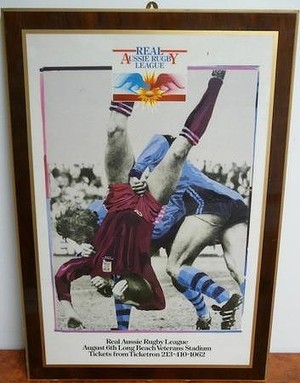
The tackle shown, an out-and-out speak tackle, was illegal in 1987 when this posted was created. It would have resulted in a four match suspension. And yet the ruling body used this photo from a lower level game and used it to promote a one off game of rugby league, played in Long Beach, to the Americans. Roy Masters says that nowadays this poster is hidden away from public view because the NRL is a little ashamed, or at least aware what a PR disaster it is. Just dwell on that penalty. Four matches. What do you think the odds are of crippling injury from that spear tackle? Greater than a tenth of a percent? And for that, a four match ban? The tackler most responsible for making a player a cripple a fortnight ago got a seven week ban. This has been criticised as excessive.
I just don’t think this game has a sound ethical basis left.
17th March 2014
Weird behaviour encountered in a build today, and I want to write it done. Chances are I will see it again one day. No doubt far enough in the future that I will forget specifics, particularly any solution I might come up with.
I have a website that has been put together in an odd way that made sense at the time. We can’t build a single package that can be used to deploy the site, it has to be built on top of a known working copy. That alone has made us at home to Mr Cockup a couple of times. So we are fixing it. Months after we should have but better late than never.
We’re transitioning to a tool for deployments called Octopus Deploy. It means I am busy making the new build scripts for all our work. It has mostly been straight forward, except for this one project, this previously kinda, sorta-unbuildable project. It’s not as simple as the others, it makes a few steps which means we have to put a bit more detail into the build script - a nuget spec - to ensure it gets everything. One of those steps is getting a bunch of files that aren’t in source control in there, ensuring they get picked up so we have a single package for the whole site. And here is where the weirdness begins.
There are eight libraries that are exhibiting an odd behaviour; when they are included in a lib folder, the build script copies them to the bin folder. At first I though there must be a reference to the files somewhere else and some of the older build script fragments are picking them up, but after grepping I have flensed away everything bar the references including them in the Visual Studio project, treating them as just files, no copying to output dir. And there’s not a command somewhere to copy the whole directory; it copies only eight files of many. Also, I can rename the lib directory to something else entirely, and it still picks up those files.
They are dependencies of direct dependencies but they aren’t being pulled from a remote server because of dependency definitions. They are definitely being copied from the lib folder and if they aren’t in lib, they don’t show up in bin. I wish I could believe msbuild is AI powered and is picking up the files because It Knows!
Now, this is only a problem because the nuget spec building the package is being told to package all files in the bin and lib directories. It’s not a very sophisticated packaging format so when it encounters these duplicate files, it blows up.
I’ve burned a few hours with my mind blown, to no avail. The only reference I can find on Google is, oddly enough, the opposite problem, the files being deleted from the bin folder, not mysteriously showing up. I’ve spent more time than I can really afford, and I expect when I get in tomorrow I am going to just go with it, make these files dependencies so they get jammed into bin because I asked for it, and remove the duplicates. But it will nag at me, this issue, until I work it out, because really…what the fuck?
Update 20/03/2014
Friend of the show and former partner in crime, So Su, reminds me that:
You and I have seen something very similar to this issue before. It turned out to be Resharper adding references to dependencies of dependants.
That sounds familiar. I can’t quite remember the circumstances he’s referring to, but I can verify that at least one of the dependencies of dependants shows up buried deep in Resharper config. Hmmm.
28th February 2014
Consciously, no shamelessly modelled/stolen from Medium. Well, full bleed image up the top and a column of text down the middle with wide margins (depending on your screen size, of course), that’s what I liked and worked into my design here. Even the limited-width column is hardly trademarked by Obvious Corp, that’s been around for years. Pretty sure Jakob Nielsen banged on about it, and if not he then others.
No, it’s the full bleed image that I fell in love with at Medium and will mark me as “inspired”. I love their fonts as well, but I fear I just don’t have the taste to apply to the problem. Maybe nxt time I have other things I want to do and need something to do in order to procrastinate.
So obviously credit goes to Obvious and Medium for their style and taste which I aspire to. Additionally, credit to Qing Wang from whom I took the YinYang theme as a starting point. I found the theme while specifically looking for something Medium inspired, and while not what I was looking for, it was something to work with and was pretty quick to get 80% of what I wanted.
As always, the final 20% takes all the time, and that is still ongoing. The archives template is pretty gross, and as suggested above, the typography needs love.
Mostly this was an exercise in learning the basics of responsive web design. Before I knew almost nothing about the finer details; now, I almost know something about it. The mechanics of making it work are there to grasp, and I reckon I may just have that grip. But again it is design itself, that component that requires taste, that eludes me. I once fancied myself a web designer, but I pretty quickly realised I was merely a web developer, best utilised at implementing the designs.
So go forth into the world, young and fresh UI. Slay me dragons and lay them before my door.
26th January 2014
At the risk of this blog turnng into the Adventure Capital making of, it turns out I am going to write this damn thing. It’s already made it off my local system out to Github.
I doubt it will ever be more than a toy I play with occasionally, but if it were, that’s almost certainly a prototype. Porting it to c# would give me more flexibility, such as mobile device apps. Ha! Look at me talk.
11th January 2014
I made a tweet about a game idea. I followed up with a Facebook post with some more words, since it can have more words. To wit
Game idea: Adventure Capital. You’re a nobleman in Greyhawk who invests in parties who go dungeon bashing. Mold your party, earn GP %s. I tried to make it more like VC funding, but it turns out I’d rather gouge out my brain that play that. Maybe more like the Football Manager type games, and maybe that seems more obvious if it were to be multiplayer.
The seed of that idea has several roots. The first is a little mobile phone game called Game Dev Story, a management simulation game themed as a video game development company. I played it for a bit after a friend recommended it. It was fun, I obsessed for a few weeks (as I am sure he knew I would and likely that was part of the reason he told me about it because he thought that would be funny), and I doubt I’ve played it since 2011. At the same time, I was noticing the Grognard movement in D&D and tangentially the proliferation of micro rule sets based on OD&D. I started thinking about what kind of rule set I would create, started creating a rule set, and finally started coding it as an engine because that would be the only way I could play test mechanics. At some stage the concepts cross pollinated. Possibly with a healthy mix of memories of the football manager games I recall seeing magazine ads for in the mid to late 1980s.
The idea has been in the back of my head for a few years now, and every now and then I’ll drag it out and dust it off and have a think about what it might look like. There would be Adventurers, obviously, and then a few bags to put them in: free agents, adventurers employed by the player, and not employed by the player. Sufficiently advanced game play would mean the player has hired more adventurers than can be placed in a single party, so a player could have many simultaneous parties with adventurers, in divisions like a sports manager game. The adventurers not hired by the player would be variously hanging around the proverbial tavern and also in rival adveturing parties competing for the same loot. Perhaps that would entail that there are rival capitalists that may be interacted with by the player.
There would be dungeons into which the adventurers to be sent to pillage, since the conceit of the game is that the player is investing in adventurers to reap a profit. There would be no direct control of what they do in the dungeon. The player shouldn’t even get updates on progress, they either come back with a full report on what happened, or just don’t come back at all. Perhaps rumours if the expedition takes long enough, of death or hints of activity. There should be a sense of the tyranny of distance. When the party does come back, they come laden with loot but also reports that provide flavour to how the party performed.
Obviously the adventurers should have statistics have some variety. Not D&D stats. I already think there are too many stats in D&D just looking at the Big Six and then you have HPs and AC and oh my god! Reduce it to maybe Tanking, Protection, Exploration, and Leadership. There should be something to represent magic use as well. Possibly stealth as well, although that could arguably be lumped in with Exploration. I think there should be more things to rate then character slots in a party, and four feels like the right number for that. Six stats? Seven? Eight feels too many. Game Dev Story had four roles and four stats, but to mix it up and encourage multi-skilled employees it has a Fatigue mechanic, so you can’t just use the same employee over and over to defeat challenges they have been supercharged for. This game would have health and after expeditions to dungeons perhaps some adventurers will need to rest up and heal. Particularly if they have been killed and brought back to life, which is defintely a mechanic which must exist. Football management games would have the player roster turning over due to some players being sacked and some players being poached by rival teams. A dungeon bash management sim should have the adventurer roster turn over due to some players being gnawed by a illithid.
Dungeons should then be a series of challenges that are defeated by the ratings the party brings with it and are rewarded with gold and enchanted items. The usual loot. And some sort of experience point system allowing the characters to be improved. Maybe you just abstract that out as spending the gold you earn from the party. Going back to Game Dev Story as an example, Research is earned during the game dev phase that can later be spent on training and leveling up your employees. The money earned from game sales are used to finance the next game, and unlocking new game dev options. I do think the gold earned from dungeons should be used to finance something unrelated to the adventurer-party-expedition mechanic. I’m just unsure what that would be.
Most importantly, there has to be an end game. I have an aversion to games that do not have a goal to reach. Traditionally those goals were finishing all the levels, or winning the race, defeating your opponent, or getting to Alpha Centauri. I never did complete Game Dev Story, but with the sports manager games there is at minimum the sense of constant renewal of the game through the turning of the seasons. You may have won the FA Cup in one season, but next season you have to start again, and probably not with the same roster of players as some leave for other teams. What I am looking for though is a victory condition, even if only have vague ideas of exactly what that might look like. A Big Bad that your party ultimately discovers as the guiding force behind all the dungeons they have cleared out, the capitalist behind it all in negative to the player?
I think it would be a fun game to play once or twice, if it could be executed well. I don’t make the mistake of believing I could create this myself. Not from a software development perspective, but in terms of game design. Game design is a skill just like any other kind of design and not one I have had any occasion to acquire. So even as I have written this, I know it will never leave the confines of my own system even were it ever actually created. But there you are, an idea for a game I have had bouncing around my skull for a few years.
3rd January 2014
Books
What a failure 2013 was in imagination and groundedness. After a final six weeks of 2012 rushing to read enough books to reach the level I set for my Goodreads challenge, as I mentioned this time last year. I even cheated, really, in reading Matchless because it was short and would get my numbers up. Instead I resolved to set the challenge number much lower and to read “challenging” books, without ever really defining what that would mean, other than that Godel Escher Bach would be one.
It’s important to set goals. If you are going to set them, though, you also need to create a routine. I read a few books right at the beginning of January, A Memory of Light being one, but for the most part I didn’t really put much thought into what these “challenging books” were that I would read. When I did finally pick one up, it was immediately before D and I went to NZ for a week and a half, and I certainly didn’t do any reading while we were touring. In the end, I didn’t read a single book I would have included in the “challenging” books list, and felt guilty for it. Enough so that I read barely any books at all in 2013. Six, according to Goodreads, plus the first three Laundry Files books which I don’t seem to have added.
I haven’t set a reading goal at all this year. Whatever I read this year is what I read. I would like to read House of Leaves, the book I picked up in February 2013, and the some non-fiction. But to do so, I need to re-establish my reading routine, which I had been eroding steadily for the last three years with…
Television
2013 was the year I finally strated cutting loose shows that had outlived their verve. True Blood and Sons of Anarchy should have been dismissed two seasons ago. Arguably True Blood should have had one season and been done with it, and Sons of Anarchy had an excellant second season, but everything afterwards has felt gratuitous tits and violence. The arcs for the characters were distorted for the sake of avoiding cast changes, and the story suffered. I understand Tara was killed in the last episode of the season just ended. She should have left at the end of season 3.
I should have dumped Californication as well, again arguably after the first season. The first season was a fun anti-redemption story. Every other season was just a pripatic tit-fest that I kept watching because Hank Moody seems so cool. It’s the last season in 2014 but I see no reason to watch it.
On the other hand, I picked up some new shows, most of which will probably pick up again in 2014. Orphan Black and Vikings earlier in the year, and then House of Cards and Orange is the New Black in the later half. Vikings is the only one I’m not sure about. It was fun - the mass battle scenes particularly the shield wall on the beach are fantastic - and Travis Fimmel was a manic charisma. If they can maintain the alien feel of the Viking culture without slipping too far into soap opera, it’ll be ok. Orphan Black is a no-brainer for a second season, it was easily the best new show of 2013 and Tatiana Maslaney should be showered in awards if there is any justice.
2013 continued my streak of not being able to bring myself to watch Game of Thrones. It started right after I read the whole extant series as the most recent book was released. I was exhausted at the time and I remain unable to commit to binge the three seasons to date. I did binge Breaking Bad in 2013 and I’m glad I did because Ozymandias was the highlight of the year.
Games
A long time friend from high school suggested I start playing a multiplayer game he was involved in, a game called Arcane Empires. I remain friends with him, despite this game being some really evil shit. It’s one of those games that exists to have players become impatient and spend real world cash for in game currency to improve their position. There’s something horrible about these games. They’re barely even games, really. It’s the grinding experience from World of Warcraft with no other mechanic to redeem it. Repetition of the same actions day in and day out. I eventually quit the game at the same time as my friend. I’ve since noticed he went on to play Clash of Clans, which I grant is at least not so egregiously monotonous.
I instead went back to Civilisation 5 and Minecraft, completely avoiding the trap of playing long-running games with the same basic mechanics repeated over and over. I am finding I gravitate back and forth between those two, with more time on Minecraft in 2012 and more time on Civilisation in 2013. I almost flipped back to Minecraft in November, but then I finally caved and purchased Gods & Kings and it breathed enough new life into the game that I have stuck with it to work out the new mechanics. Not that I’ve ever been much good, hovering around the middle difficulties. In the first game I could play The Mongol Tactic on the highest difficulty, but that’s not a winning strategy since they a) nerfed the Chariot, and b) ramped up the Unhappiness penalties for too many cities.
I noticed on New Years Day while I was bored that I was playing Tiny Wings and trying to get to Island 8. I was trying to get to Island 8 while bored during a practice run of my team’s end-of-sprint demo in January 2011. So yeah.
Music
I’m old.
I really enjoyed Lorde’s album. Other than that, I’m old, and don’t really encounter new music that readily. I spend more time on podcasts these days.
So Accidental Tech Podcast, Mike Duncan’s new podcast Revolutions, The Talk Show, and The Incomparable.
9th November 2013
Several months ago I talked about how I use a request to write some simple code in interviews to try and gain some insight into how the interviewee thinks. Specifically I discussed the Swap(int,int) method and what I could discern from it, depending on how far the interviewee could go with it. In the months since then I’ve done a few interviews that have allowed me to develop the concept further, and so I am going to talk about some of my learnings.
The interviews I was conducting earlier in the year were all phone interviews, and I think this makes it difficult to really do coding questions. They were phone interviews by necessity as the subjects were in Manila and I was in Sydney, trying to find a suitable subject to be the core of an offshore development team. I found that two thirds of the dozen or so candidates I interviewed were able to put together the temp variable answer but only one was able to get the arithmetic version, and even then it took prompting with the first line. Most difficult was the inability to watch them working and thinking. The setup just didn’t support it and is to my discredit that I didn’t work to improve the situation by demanding a webcam be setup.
The last four weeks I have been interviewing candidates in person. Despite being a better standard of candidate they have also struggled with the arithmetic solution, and certainly no-one has got it without being given the first line. Watching people struggle with it gave me a light bulb moment though. I actually don’t want the kind of candidate that would come up with that piece of code, so why am I trying to make people write it? But how do I get to the ultimate insight unless I have them critique that piece of code?
The whole point of the question is to determine if they are cowboys or engineers by having them look at a piece of cowboy code and give their opinion of it. So…why not just give them the code? The value I was finding in having people applying for a senior developer position write the temp variable approach was vanishingly slight, and conversely they were all struggling to get to the next, and in my eyes vital, step. So now I have it on the whiteboard when they walk in, see if they look at it and if they do what their reaction is. I do the introductions and ask them to discuss their current role for a few minutes. And then I ask them what the computation is in the function written on the board. Or maybe I ask them what they would call the function.
void X(ref int a, ref int b){
    a = a + b;
    b = a - b;
    a = a - b;
}
After I switched, within a couple of interviews I knew I had made the right move. I discovered I was able to observe other basic qualities of the candidate as they attempted to answer the question.
The first is their approach to learning a new body of code. For example, my approach to learning what this piece of code would do is to run it with a couple of sets of values. You could probably make an educated guess after the first set of values were swapped and I’d probably hazard a guess at that point and then run it again quickly to make sure.
The second is their ability to deal with uncertainty. My ability to cope with uncertainty has historically been pretty poor, and I have to make an effort to let stress and annoyance take over when I’m in that position. I’m looking for at least that, an effort made to push past the stress and at least try to come up with an answer.
Incidentally, one of the candidates who did get the arithmetic solution when asked to write it, gave me an answer I had never considered before when I followed up with what was wrong with it. In my previous post I had pointed out that it was pointless to try and beat the compiler at memory management by skipping the temporary variable. However this candidate pointed out that the temp variable was the better optimisation anyway, because it was all assignment, and thus only memory. As soon as you have to do arithmetic computation you are using the CPU, and that will be slower.
UPDATE
I took him at face value because, well cause it sounded like it made sense and because I didn’t really care about the particulars. It’s not like I was hiring him to come in and write code an OS to be embedded in a 1980s wristwatch. But I should point out at least one person believes it is wrong.
12th July 2013
I should have thought that the bare fact that a function labeled “Save as Markdown” generates an HTML file was self-explanatory as a bug report and yet…
Fair enough. Whatever else Twitter is good for, bug reports are not it1. So here goes.
Dave. HTML is most definitely not Markdown.
Now I understand that the functionality is supposed to be doing exactly as I have described, applying a Markdown parser to Markdown in the document to produce an HTML document. I can indeed read the Fargo docs. Still, that’s not the common understanding of the sentence fragment “Save as Markdown”. It might even be the opposite of said common understanding.
Furthermore, my Fargo doc is, so far, a three deep tree. So even if I did want HTML, I assure you, I did not want HTML that lost the tree structure. It’s particularly galling since the HTML that I might want - if indeed it was HTML I wanted which I didn’t - is already in the page, right there in the DOM. But rather than put that in the HTML file, Fargo applies a lossey conversion and dumps it out as a list. Not a list in the sense of a series of li elements, but a list in the sense of a series of space seperated words.
But yes, I do understand that the tree depths should be thought of as headers, and thus marked up as headers.
What I want is a Markdown version of what I have produced in Fargo. Which is to say, the OPML fragment
<outline text="Getting Started">
        <outline text="Creating Your Character" created="Mon, 08 Jul 2013 11:53:03 GMT">
            <outline text="Generating Attributes" created="Mon, 08 Jul 2013 11:53:08 GMT"/>
would be output as
* Getting Started
    * Creating Your Character
        * Generating Attributes
OPML is not useful to me, it is not readily editable in a text editor when I don’t have access to Fargo. Hence, my desire for a text version. Fargo is a tool for quickly restructuring the document by moving sections around, and a pretty good one. OPML, on the other hand, brings insufficient benefits to the table to offset the lock in.
UPDATE
If any of you were waiting with bated breath for a response from Winer, there has been none. Not on his blog, not via email, or via Twitter.
1. : Not there appears to be a formal way to report bugs.
18th June 2013
If you are going to look at the problem of 4th edition D&D from the perspective of Purity, what could be more pure an expression of D&D than 4th edition? The greater majority of its critics use purity as their weapon of choice. It’s attacked for having strayed to far from tabletop and morphing into something more like World of Warcraft. Or Diablo. It’s attacked for its long, long…loooooong bouts of combat, reducing whole sessions to a single encounter in extreme cases. It’s attacked for the mini-game like Skill Challenges, which reduces non-combat encounters to a series of dice rolls rather than an acting and/or puzzle-solving exercise. It’s attacked for not being D&D at all, but something else designed to appeal to video gamers.
From a certain point of view though, it is the purest form of the game since Chainmail. Remember, the roots of the game are in the war gaming community, gamers who devoted whole tabletops to platoons of miniatures representing Napoleonic period troops, WW2 divisions, and - eventually - mythic, fantastical creatures. The birth of the game is in the heros and superheroes of those fantasy games stepping off the battlefield and into the dungeon. The earliest rules were hardly more than a shim on a game that was a fantasy skin over simulations of Famous Battles of the Second Millennium of the Common Era. Masterpiece Theatre it was not. Look carefully at descriptions of early play and you’ll find illuminaries such as Gygax reducing non-combat encounters - when he was rushed/bored/out of ideas - to 50/50 dice rolls. It’s even a guideline formalised as early as 2nd ed and informally since the first published rule sets.
That’s all sophistry though. I don’t think 4th ed is the purist form of D&D. I think it is terribly far from being a pure form of D&D, although I think it might actually be closer than 3.5 with its proliferation of classes. Maybe. I can’t actually be sure since I barely played 3rd ed, and never played 3.5 or 4th ed. Closest I have come is ready the rule sets and watching showcase games of 4th ed played the Penny Arcade crew, Wil Wheaton, and Scott Kurtz. I suspect those four could make Snakes & Ladders a riotous explosion of creativity, so not really a yardstick.
From a certain point of view? That’s a phrase that, to my mind, comes freighted with context. Obi-wan Kenobi said that, when he’s just finished owning up to lying his arse off. But in this case, I really do mean it. Because from a certain point of view, D&D 4th edition is a pure expression of its sources.
I do happen to think that it hews closer to video games like World of Warcraft and Diablo. It does so unashamedly. Whereas in previous editions a player and the DM might use their nous to have a fighter character anchor a combat, 4th ed makes a game mechanic by importing concepts like Aggro from games like World of Warcraft. Combat is both amped up with tactical options - even if I get the sense that many combats follow much the same series of tactical moves - while defanging it with so many sources of healing and character builds that have the potential to make a character nigh invulnerable. And for all the variety and options that can go into builds, the classes fill rigidly defined roles: The Tank, The DPS dealer, The Buffer, &c. The roles were there in old style D&D, but not so rigidly and not so all-consumingly.
Combat in 1st ed was nasty, brutish, and short. Dungeons crawls were like climbing Everest, something done in many stages, with advances followed by retreats to recover and consolidate. That’s an experience entirely foreign to a gamer who has come to RPGs via MMOs. The breakout game of the genre - World of Warcraft - actively penalised retreating from a dungeon (that is to say, an Instance) by resetting the whole thing exactly as it was before.1 And while combat can be lethal in an MMORPG, with party wipes aplenty, ultimately it has little impact, the players just respawn with the only repercussion being time lost and gold to be spent to repair and restock.
I don’t like D&D 4th Edition, and from my reading of the early play test materials I don’t like D&D Next either. But in a way I respect them. I respect them because I recognise that they embraced their inspirations, their source material, their Appendix N if you like. My Appendix N is different to Gygax’s, but it has one thing in common, that they are books and stories. The Appendix N of modern D&D is World of Warcraft, Everquest, Final Fantasy, et. al. The old inspirations lent themselves to a different style of play, a style that I preferred.
As I said, I’ve never actually played the 4th edition. Merely read the rule books. That and three dollars will get me a cup of coffee. And showcase games involving witty and imaginative players prove the game can be fun, even if it is fun in a different mode to the games I played when younger. I drifted away from the game when I finished inversion and moved to Sydney, away from my gamer friends and towards time consuming jobs. But I also drifted away because the game drifted away from me. The signs were there from third edition that the game was skewing towards the market more accustomed to quicker gratification and mechanical manufacture of avatars over organic formation of characters. Feats in particular contributed to this uneasy feeling for me. So I stopped playing, because there was no joy left to it.
There’s this thing called the internet now and I can’t help but wonder, just how hard would it be to find a game of 1st edition to play through the medium of online communications?
1. : Which is not to say a canny DM wouldn’t repopulate a dungeon when the PCs had retreated. The best do, the ones who are thinking people, not automatons reading straight off the page. They’d repopulate, but organically, not a complete mechanical resetting. ↩
<< prev | next >>